


In the latest instalment of our supply chain & logistics industry executive interview series we speak to ALS’s Genc Sabani about how data-driven customs strategies and proactive compliance are helping businesses reduce risk and unlock hidden value across their supply chains…
1. What are the most important changes you’re seeing in the way customs authorities are managing compliance and monitoring trade today?
Customs authorities such as HM Revenue & Customs (HMRC) are increasingly moving toward data-led compliance and post-clearance monitoring rather than relying purely on border checks. With systems such as HMRC Customs Declaration Service (CDS), authorities now have the ability to analyse declaration data patterns, identify anomalies in valuation, classification, and origin, and trigger targeted audits.
As a result, companies must ensure that their internal data and processes are fully aligned with their declarations, as customs authorities now expect traders to maintain a strong internal compliance framework supported by accurate digital records.
2. As customs compliance becomes more data-driven, what role do proactive customs internal reviews play in helping companies identify risks before authorities do?
Proactive customs internal reviews are becoming essential because they allow companies to assess their customs landscape before authorities identify potential issues.
At ALS, our Health Check approach is supported by our Customs Analytics Tool (CAT), which analyses historical declaration data to identify potential compliance gaps, inconsistencies, or financial exposure.
The CAT tool enables businesses to detect:
- Classification inconsistencies
- Origin declaration risks
- Valuation discrepancies
- Missed duty relief opportunities
- Mitigating double duty hit
Through our free trial CAT analysis campaign offered to businesses in the UK, companies can gain initial insights into their customs data year pattern and identify areas that may require corrective action or optimisation before any regulatory review occurs.
3. What role can data-driven customs solutions play in supporting the entire supply chain, not only from a compliance perspective but also in improving visibility and identifying opportunities for optimisation?
Customs declaration data is one of the most underutilised assets within supply chain. As of November 2025, the customs data is available for free from HMRC.
Through data-driven customs analysis using the ALS CAT platform, companies can transform their declaration history into actionable intelligence that supports both compliance and financial optimisation.
For example, data analysis can identify:
- Duty reclaims opportunities resulting from incorrect tariff classifications, valuation, or origin declarations.
- Overpayments due to misapplication of trade agreements.
- Opportunities to apply special procedures such as Customs Warehousing or Inward Processing to avoid double duty hit.
- Risks that could trigger audits from HMRC and place them in an audit-proof position.
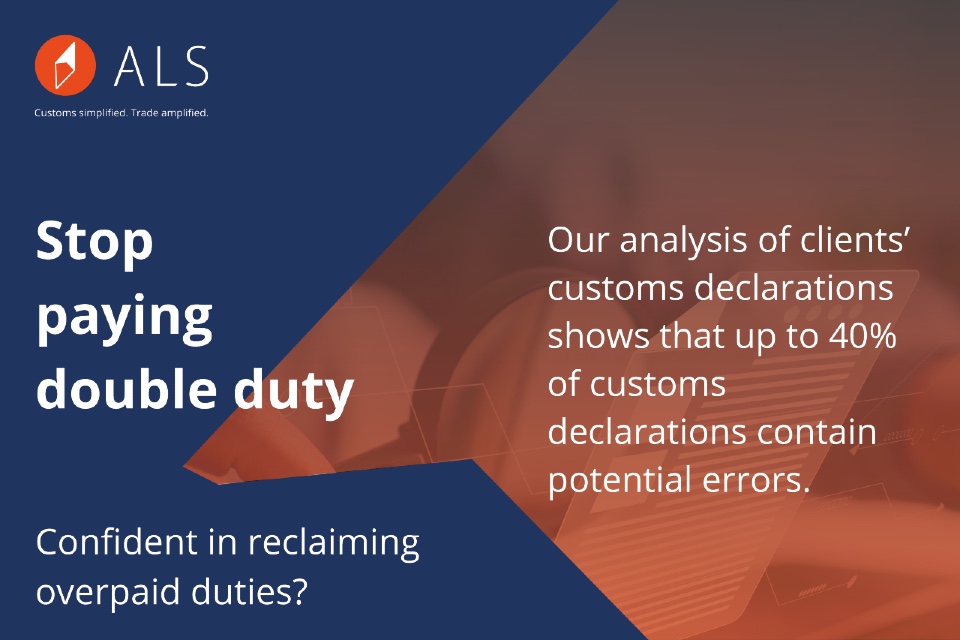
This level of visibility allows businesses not only to remain compliant but also to optimise supply chain costs and avoid unnecessary duty exposure, including situations where companies may be paying duty twice on the same goods.
4. Many businesses hold years of customs data but rarely analyse it. How can an external customs service provider help turn that data into actionable insights through health checks?
Historically, we have observed that many businesses in the UK do not fully comply with their customs record-keeping obligations and instead rely on customs agents to retain and provide access to declarations records. From a compliance perspective, this creates significant exposure, as the legal responsibility to maintain complete and accurate customs records ultimately sits with the trader, not the broker.
At the same time, some companies do maintain years of customs declaration data and supporting documentation but rarely perform any structured analysis of that information. As a result, valuable insights remain untapped, whether to identify compliance risks, inconsistencies in declarations, or potential duty recovery opportunities.
At ALS, we are equipped with advanced customs solutions in record keeping, distribution and analytics tools, such as the ALS CAT platform, which can review large volumes of historical declarations data and identify patterns, inconsistencies, and financial opportunities.
This approach converts raw customs data into practical operational insights, allowing businesses to strengthen compliance while unlocking potential financial recoveries.
5. How can companies effectively manage the full scope of customs operations, from declarations to warehousing and inward processing regimes, to improve efficiency and reduce risk?
Effective internal customs management requires a holistic approach across the entire supply chain rather than focusing solely on the customs agents filing out customs declarations.
Companies need to ensure that their customs declarations are fully aligned with their internal systems, including ERP and product master data, as well as with their classification and origin management processes. In addition, businesses should carefully consider the strategic use of special procedures such as Customs Warehousing and Inward Processing as part of their broader customs framework.
When these elements are implemented and managed effectively, organisations can significantly reduce the risk of double duty exposure, benefit from the deferral or suspension of duties, and improve overall cash flow management. At the same time, this structured approach strengthens compliance with authorities such as HMRC. Ultimately, the key lies in integrating operational customs procedures with data analytics, enabling companies to continuously monitor their customs compliance landscape and identify opportunities for financial optimisation.
6. From your perspective, what has been one of the biggest challenges for customs service providers in the past year?
One of the biggest challenges has been the increasing complexity of customs regulations, application changes and the growing expectations from authorities regarding trader compliance.
Many companies still rely heavily on brokers to manage declarations, but do not always maintain strong internal customs governance structures. This can create challenges when data inconsistencies appear or when audits are initiated by authorities such as HMRC.
At the same time, customs service providers are expected to provide strategic advisory services, not just operational declaration processing.
7. What strategies or solutions do you think can help companies overcome these kinds of challenges?
Companies can overcome these challenges by adopting a proactive compliance strategy supported by data analytics and regular customs reviews. This involves conducting periodic customs reviews and analysing declaration data through advanced tools such as the ALS Customs Analytics Tool (CAT) platform, which helps identify compliance risks as well as potential financial opportunities. Businesses should also review their eligibility for customs special procedures, including Customs Warehousing and Inward Processing, which can significantly optimise duty exposure and supply chain efficiency.
Alongside these measures, implementing internal compliance frameworks aligned with AEO best practices can strengthen governance and transparency across customs operations. By taking this structured and forward-looking approach, companies can move from reactive compliance toward proactive customs management, ultimately reducing risk while improving operational and financial efficiency.
8. What role do you think technology and data are going to play in the customs and trade sectors this year?
Technology and data utilisation will continue to play a central role in customs compliance and supply chain optimisation. Customs authorities are already leveraging advanced analytics to monitor trade flows and detect irregularities, which means businesses must develop similar capabilities in order to remain both competitive and compliant.
Platforms such as the ALS Customs Analytics Tool (CAT) enable companies to analyse large volumes of customs declaration data, identify potential compliance risks at an early stage, detect duty reclaim opportunities, and support more informed supply chain decision-making.
Ultimately, the future of customs management will depend on the successful integration of digital analytics with operational customs expertise, allowing organisations to manage compliance more efficiently while also unlocking opportunities for financial optimisation across their supply chains.